

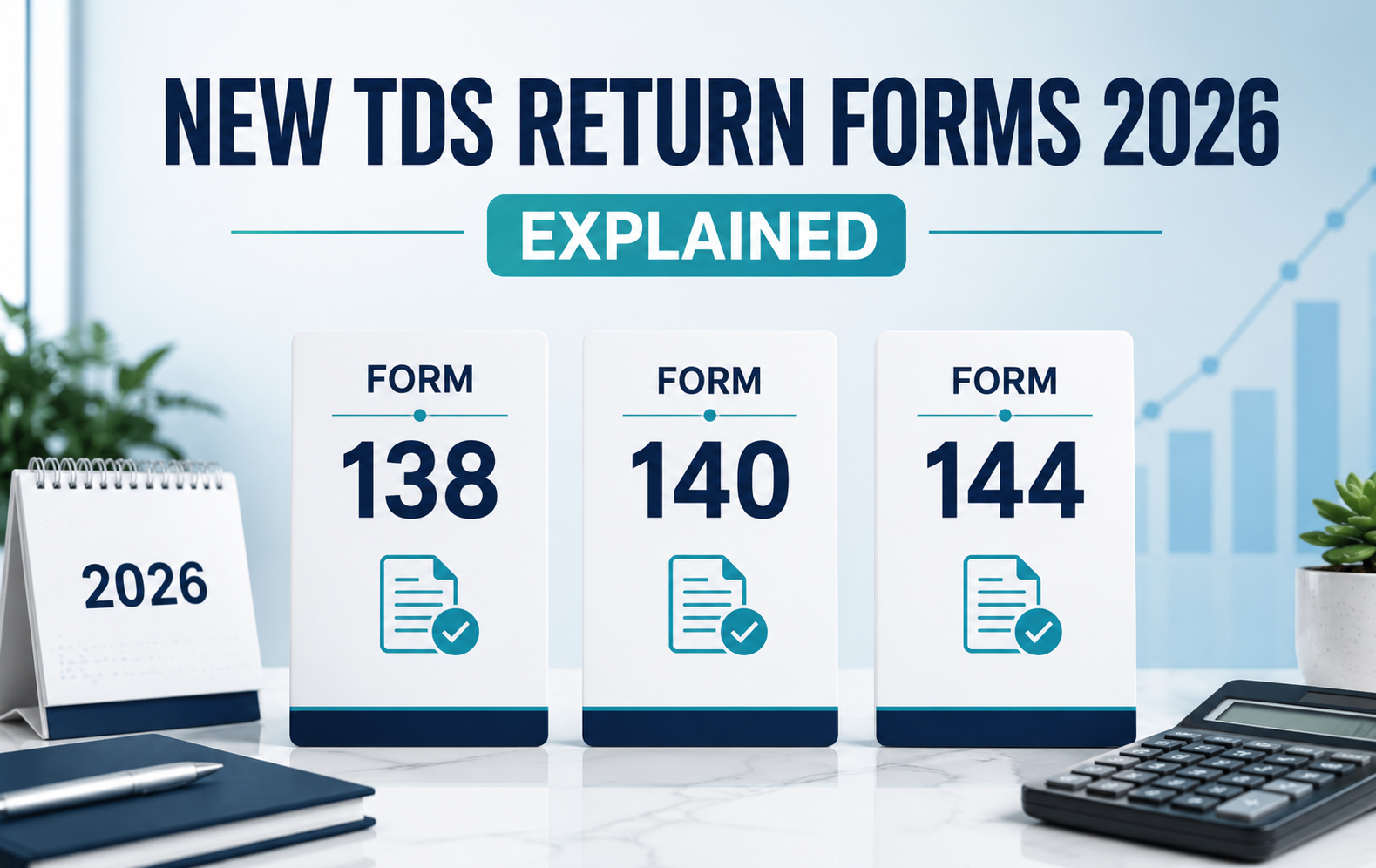
India's TDS reporting framework has changed under the Income Tax Act, 2025 and the Income Tax Rules, 2026. The new TDS return forms 2026 introduce revised form numbers for quarterly TDS statements, including Form 138 for salary-related TDS, Form 140 for non-salary payments to residents, and Form 144 for payments other than salary made to non-residents. The Income Tax Department has made these quarterly forms available on its e-Filing portal.
For employers, businesses, professionals and other tax deductors, understanding these changes is important because the form numbers have changed even though the underlying reporting responsibilities continue to follow the applicable TDS provisions. This guide explains what each new form means, which earlier form it replaces, applicable due dates, who needs to file it, and how businesses can prepare for the transition.
Call us: +91 63669 09909
What Are the New TDS Return Forms 2026?
The new TDS return forms are revised statutory forms introduced under the Income Tax Act, 2025 and Income Tax Rules, 2026. They reorganize the existing TDS reporting framework by assigning new form numbers to different categories of deductions.
The key replacements relevant to regular quarterly TDS reporting are:
|
New Form |
Earlier Form |
Purpose |
|
Form 138 |
Form 24Q |
TDS on salary and certain specified senior-citizen income |
|
Form 140 |
Form 26Q |
TDS on non-salary payments to residents |
|
Form 144 |
Form 27Q |
TDS on non-salary payments to non-residents |
|
Form 143 |
Form 27EQ |
TCS reporting |
The Income Tax Department's official mapping guide confirms these form replacements.
The change is therefore not simply a renumbering exercise for employers and deductors. Payroll, accounting and tax teams need to select the correct form and ensure their reporting systems reflect the new framework.
New TDS Return Forms 2026: What Has Changed?
The biggest change is the replacement of familiar TDS statement numbers with new forms under the Income Tax Act, 2025.
For many businesses, the most noticeable change will be moving from the earlier Forms 24Q, 26Q and 27Q to Forms 138, 140 and 144.
Form 138: Earlier Form 24Q
Form 138 is the new quarterly statement for reporting TDS deducted from salary. It is the new form corresponding to Form 24Q.
The Income Tax Department states that Form 138 is filed by employers and specified banks for reporting TDS deducted on salary, pension or specified interest income. Employers that deduct tax from employees' salaries therefore need to understand the new form requirements as part of their salary TDS return filing process.
In simple terms:
- Earlier Form: 24Q
- New Form: 138
- Primary use: Salary-related TDS reporting
- Typical filers: Employers and specified banks
- Frequency: Quarterly
The official form mapping also identifies Form 138 as the replacement for Form 24Q.
Form 140: Earlier Form 26Q
Form 140 replaces Form 26Q for quarterly TDS statements covering non-salary payments made to residents.
This can apply to payments such as professional fees, commission, brokerage, rent and other payments where TDS is applicable. The Income Tax Department describes Form 140 as a quarterly statement for persons deducting TDS on non-salary payments made to residents.
For example, if a company deducts TDS from payments to an Indian resident professional, the corresponding quarterly reporting falls under Form 140 rather than the earlier Form 26Q.
Form 144: Earlier Form 27Q
Form 144 replaces Form 27Q and applies to TDS deducted on payments other than salary made to non-residents.
For example, where an eligible payment such as interest, fees or other income is made to a non-resident and TDS is deducted, the deductor may need to report the transaction through Form 144.
The official mapping guide confirms that Form 144 corresponds to the earlier Form 27Q.
Who Needs to File Form 138?
Form 138 for employers is primarily relevant to employers that deduct TDS from salaries. Specified banks may also have reporting obligations for certain pension or interest payments covered by the form.
The form is filed quarterly, so employers need to maintain accurate payroll and TDS records throughout the tax year rather than waiting until the reporting deadline.
Businesses should particularly check:
- Employee salary and taxable income records
- TDS deducted during each quarter
- PAN and other deductee information
- Tax deposited against the relevant deductions
- Corrections or adjustments required before filing
- Reconciliation between payroll records and TDS records
Accurate payroll data can make the transition from Form 24Q to Form 138 much smoother.
What Is the Form 138 Due Date?
The Form 138 due date follows the quarterly TDS statement schedule prescribed by the Income Tax Department.
|
Quarter |
Period |
Form 138 Due Date |
|
Q1 |
April–June |
31 July |
|
Q2 |
July–September |
31 October |
|
Q3 |
October–December |
31 January |
|
Q4 |
January–March |
31 May of the following financial year |
These dates are specified in the Income Tax Department's Form 138 guidance.
The same quarterly schedule is also applicable to Forms 140 and 144 according to their respective official user manuals.
Form 138 TDS Return: How Does Filing Work?
The Form 138 TDS return is filed as a quarterly statement through the Income Tax e-Filing system.
A practical filing workflow includes:
- Compile payroll information
Collect salary, taxable income and TDS deduction details for the relevant quarter. - Verify deductee information
Check employee PAN and other required details for accuracy. - Reconcile TDS deductions and deposits
Ensure the tax deducted from salary corresponds with the tax deposited and recorded in the relevant systems. - Prepare the quarterly statement
Use the applicable Form 138 filing facility and provide the required information. - Validate the statement
Review the information carefully before submission to identify inconsistencies or missing details. - Submit through the e-Filing portal
Complete the applicable filing and retain the acknowledgement and supporting records.
The Income Tax Department currently lists Form 138 among the quarterly forms available on its e-Filing portal. The Form 138 TDS return is filed as a quarterly statement through the Income Tax e-Filing system. Businesses and employers that need professional assistance can use TDS return filing services to help prepare, review, and submit their applicable TDS statements.
Form 138 vs Form 140 vs Form 144
The easiest way to understand the three forms is to look at the type of payment and the residency status of the recipient.
|
Form |
Replaces |
Payment Type |
Recipient |
|
Form 138 |
Form 24Q |
Salary and specified covered income |
Employees / specified senior citizens |
|
Form 140 |
Form 26Q |
Non-salary payments |
Residents |
|
Form 144 |
Form 27Q |
Non-salary payments |
Non-residents |
This distinction helps payroll and finance teams identify the appropriate quarterly statement without relying solely on the old form numbers. The official Income Tax Department mapping confirms these relationships.
Why Should Businesses Prepare for the New Forms?
The form-number changes affect the way businesses identify, prepare and submit their quarterly TDS statements. Updating internal processes early can reduce confusion when accounting, payroll and compliance teams begin working with the new forms.
Businesses should consider:
- Updating payroll and accounting software
- Reviewing TDS reporting workflows
- Training payroll and finance teams
- Updating internal compliance checklists
- Checking whether software supports the new forms
- Reconciling tax deductions and deposits regularly
- Keeping records of submitted statements and corrections
For companies in Bangalore and across India, these preparations can be particularly useful where payroll, finance and tax functions operate across multiple teams or locations.
Businesses should also review related compliance processes, including payroll records, tax return preparation, accounting workflows, and TDS reporting procedures to ensure that information remains consistent across their tax records.
Businesses managing multiple tax obligations should also keep their GST compliance processes organized, including GST return filing online, reconciliation, and other applicable periodic filings.
Common Mistakes to Avoid When Filing New TDS Forms
A change in form numbering can create avoidable errors if businesses continue using old workflows without checking the new requirements.
Common issues include:
Using the Earlier Form Number
The earlier Form 24Q, 26Q or 27Q terminology may still appear in older accounting records and software documentation. Businesses should distinguish historical records from the applicable current form.
Choosing the Wrong Form
The correct form depends on the nature of payment and, where relevant, the recipient's residential status. Salary payments, resident non-salary payments and non-resident non-salary payments should not be treated as the same category.
Ignoring Quarterly Deadlines
Missing a quarterly statement deadline can create compliance problems. Maintaining a calendar for 31 July, 31 October, 31 January and 31 May can help finance teams plan ahead.
Failing to Reconcile Records
Differences between payroll, accounting records, tax deductions and deposited amounts can complicate the filing process. Reconciliation should be completed before submitting the quarterly statement.
How Can Employers Prepare for Form 138?
Employers moving from Form 24Q to Form 138 should begin by reviewing their payroll and TDS reporting process.
A simple preparation checklist is:
- Map existing Form 24Q workflows to Form 138.
- Confirm that payroll software supports the applicable new form.
- Review employee PAN and salary information.
- Reconcile quarterly TDS deductions with deposited amounts.
- Track the applicable quarterly deadline.
- Maintain copies of filed statements and acknowledgements.
- Review official Income Tax Department instructions before filing.
The Income Tax Department's current portal provides Form 138 guidance and confirms the new form's availability.
What Should Businesses Know About Form 140 and Form 144?
Form 140 and Form 144 become relevant when the payment is not salary.
Form 140 applies to non-salary payments to residents and replaces Form 26Q. Form 144 applies to non-salary payments to non-residents and replaces Form 27Q. Both are quarterly statements with the same broad quarterly due-date cycle as Form 138.
Businesses making payments across different categories should therefore classify transactions correctly before preparing their quarterly TDS statements.
For organizations with domestic vendors, consultants and international payments, this classification is especially important because the applicable form can change depending on the nature of the payment and the recipient.
Conclusion
The new TDS return forms 2026 introduce a revised numbering system that businesses and employers need to incorporate into their compliance workflows. Form 138 replaces Form 24Q for salary-related TDS reporting, Form 140 replaces Form 26Q for non-salary payments to residents, and Form 144 replaces Form 27Q for non-salary payments to non-residents.
Businesses that need help understanding their wider tax-compliance requirements can also consult an income tax consultant online for personalized guidance and support.
For employers, understanding the Form 138 due date and updating payroll processes should be an early priority. Businesses can also review their accounting and TDS workflows to ensure the appropriate form is selected for each category of payment. Where professional assistance is needed, Taxfilr can help businesses review their tax-compliance requirements and stay organized with TDS return filing. Learn more about New TDS Return Forms to understand how professional support can simplify the process.
Businesses looking to simplify their overall tax-compliance process can also explore tax filing services online for support with applicable tax filing and reporting requirements.
Need Help With TDS Return Filing?
Stay on top of your TDS compliance with the right forms, accurate reporting, and timely filing. If you need assistance with Form 138, Form 140, Form 144, or other TDS-related requirements, the Taxfilr team can help you understand the process and complete your filing efficiently.
Call us: +91 63669 09909
Email: contact@taxfilr.com
Frequently Asked Questions
Is Form 138 the new Form 24Q?
Yes. Form 138 is the new form corresponding to the earlier Form 24Q for quarterly reporting of TDS on salary and certain specified income covered by the form. The Income Tax Department's official mapping guide identifies Form 138 as the replacement for Form 24Q.
Who has to file Form 138?
Employers that deduct TDS from salaries generally need to file Form 138 quarterly. The form also covers certain reporting by specified banks for pension or interest income covered under the applicable provisions.
What is the due date for Form 138?
The quarterly deadlines are 31 July for April–June, 31 October for July–September, 31 January for October–December and 31 May of the following financial year for January–March.
Is Form 140 the new Form 26Q?
Yes. Form 140 replaces Form 26Q for quarterly TDS reporting relating to non-salary payments made to residents. Examples can include applicable professional fees, commission, brokerage and rent payments.
Is Form 144 the new Form 27Q?
Yes. Form 144 corresponds to the earlier Form 27Q and covers quarterly reporting of TDS on payments other than salary made to non-residents.
Do the new form numbers change the need to deduct TDS?
The change in form numbering does not by itself mean that every payment becomes subject to TDS or that existing TDS obligations automatically disappear. Businesses should determine whether TDS applies based on the relevant provisions and then use the applicable reporting form.
Where can businesses verify the new TDS forms?
Businesses should verify current requirements through the official Income Tax Department e-Filing portal and the applicable Income Tax Rules, 2026. The Department currently provides user manuals and form-mapping guidance for Forms 138, 140 and 144.