

For Indian citizens with income sources, filing income tax forms accurately and promptly is essential. Failing to do so can lead to significant consequences, impacting your income. While many are aware of the obligation to pay taxes when their income surpasses a specific threshold, confusion often arises during tax season regarding filing income tax returns (ITRs). Neglecting to file these forms is as critical as paying your tax bill for staying in compliance, and here's a brief overview of the consequences when an income tax return is not filed.
Overview of Income Tax Return
An income tax return is a form informing the government about your income, and all taxable individuals must routinely file it. The Internal Revenue Service stresses the importance of timely ITR submission. Failure to report to the government can lead to tax evasion charges, fines, and future issues. Forgetting to file ITRs may result in penalties, and stopping or delaying filing can incur interest on the taxable amount owed to the government.
Advantages of Filing a Tax Return
- Preparing to file your ITR can simplify the process of obtaining a loan from a bank or financial institution.
- Individuals can claim tax refunds as required.
- Filing taxes allows for faster visa approval and processing.
- It prevents fines and interest on tax debt for individuals and businesses.
- It serves as proof of both your salary and address.
- It ensures legal compliance.
Not Filing ITRs: Exploring the Consequences
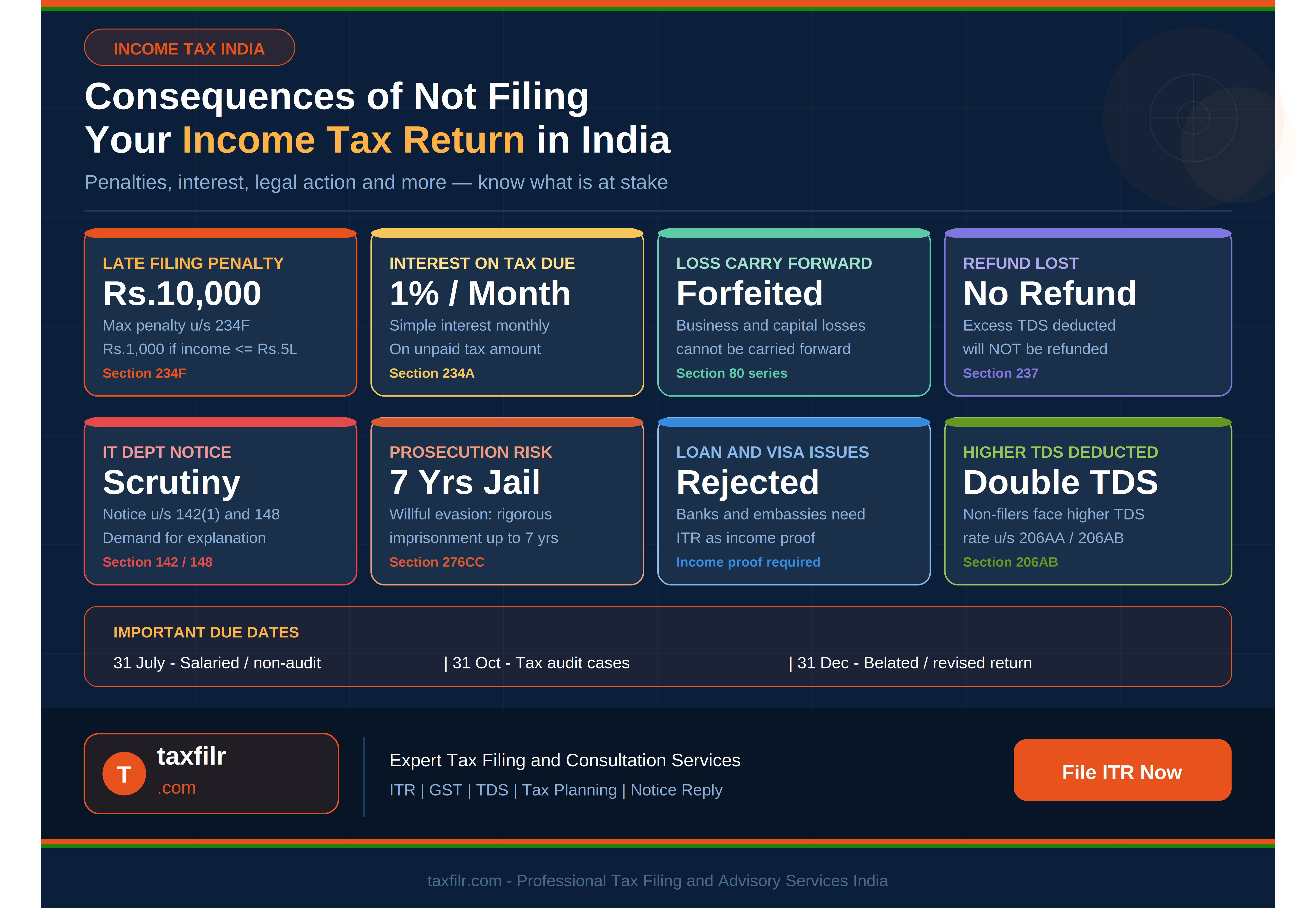
The following will occur if your income tax returns are not filed by the deadline:
Efficiently Update Your Income Tax Returns
Correcting errors in your ITR requires following a specific system. Previously, taxpayers had a two-year window for reviewing and resubmitting incorrect ITRs, but this has now been limited to one year by the government. Delay in filing returns can lead to consequences, and rectifying any issues becomes more challenging with time.
Consequences of Submitting a False Tax Return
Filing false claims for income tax refunds (reporting income falsely , or creating fictitious losses ) can lead to harsh penalties. A three-tiered fee system shall apply in the event income tax returns are not filed by the due day, with a penalty of 5,000 if filed after the due day and 10,000 if filed later. Taxpayers earning less than 5,000,000 annually are limited to 1,000 for cost payable.
Final Thoughts
Failing to pay taxes above the exempt criteria can result in a penalty of up to Rs 5000 imposed by the income tax officer. There could be severe punishment for not filing the returns. Thus, it becomes very important to file ITR to avoid penalties and legal consequences.