

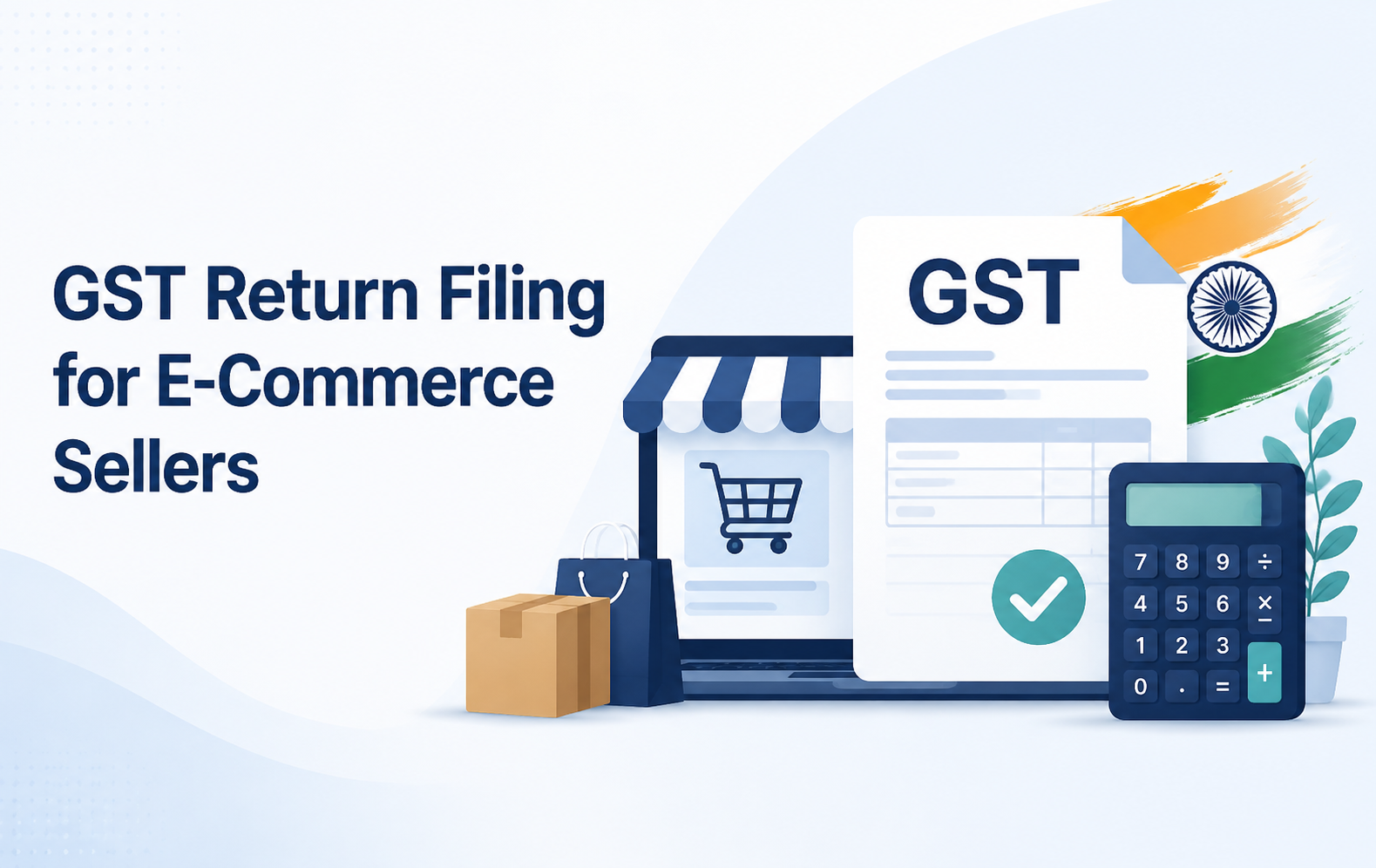
Selling products on Amazon, Flipkart or Meesho can simplify customer reach, but GST compliance still requires careful attention. GST return filing for e-commerce sellers involves reporting sales correctly, reconciling marketplace statements, claiming eligible input tax credit, and ensuring that tax liabilities match the transactions recorded in your books and GST portal.
For online sellers in Bangalore and across India, even small mismatches between marketplace reports, invoices, returns and GST records can create reconciliation problems. This guide explains how GST compliance works for marketplace sellers, which returns may apply, how TCS affects reconciliation, common mistakes to avoid, and how sellers can keep their GST records organized.
Call us: +91 63669 09909
What Is GST Return Filing for E-Commerce Sellers?
GST return filing for e-commerce sellers means reporting taxable sales, purchases, tax liability and eligible input tax credit to the GST authorities through the applicable GST returns. Sellers using marketplaces need to reconcile their own sales records with transaction data and marketplace reports before filing.
Depending on the seller's registration status, turnover, business model and applicable GST rules, compliance may involve:
- Reporting outward supplies in GSTR-1
- Paying the tax liability through GSTR-3B
- Reconciling marketplace sales and adjustments
- Checking eligible input tax credit
- Accounting for sales returns, cancellations and discounts
- Reconciling tax collected at source (TCS), where applicable
- Maintaining valid tax invoices and supporting records
The exact compliance requirements can vary based on the seller's circumstances and applicable notifications. Sellers who prefer professional assistance may also explore GST return filing online services for return preparation and reconciliation support.
Is GST Registration Required for Amazon, Flipkart and Meesho Sellers?
GST registration requirements for marketplace sellers depend on the nature of supplies, the e-commerce operator involved and the applicable provisions or exemptions. Under Section 24 of the CGST Act, certain suppliers making supplies through an e-commerce operator that is required to collect TCS are subject to compulsory registration. However, specific exemptions and notified arrangements can change the position, so sellers should verify their current eligibility rather than relying only on the general turnover threshold.
Before registering or selling through a marketplace, check:
- Whether your products are taxable or exempt
- Your aggregate turnover
- Whether the marketplace is covered by the relevant TCS provisions
- Whether any exemption or special enrolment facility applies
- Whether you make inter-State supplies
- Whether your business has registrations in multiple States
This is particularly relevant for small sellers because GST treatment is not determined by marketplace sales alone.
How Does GST Filing Work for Marketplace Sellers?
The basic process is to collect marketplace transaction data, reconcile it with invoices and books, report eligible outward supplies, calculate tax liability and file the applicable returns within the prescribed timelines.
Step 1: Collect Marketplace Reports
Download the relevant sales, settlement, fee, return, cancellation and adjustment reports from Amazon, Flipkart, Meesho or other platforms.
Step 2: Match Sales With Invoices
Reconcile marketplace orders with tax invoices. Check taxable value, GST rate, place of supply, customer details and credit or debit adjustments.
Step 3: Reconcile TCS
If tax has been collected at source by the e-commerce operator, compare the TCS appearing in GST records with marketplace statements and the credit available in your electronic cash ledger.
Step 4: Prepare GSTR-1
Report outward supplies in the appropriate tables of GSTR-1 based on the nature of transactions and applicable reporting requirements.
For monthly filers, GSTR-1 is generally due on the 11th of the following month. Quarterly filers under QRMP generally file GSTR-1 by the 13th of the month following the quarter.
Step 5: File GSTR-3B
GSTR-3B is used to declare GST liabilities and discharge the applicable tax. Monthly filers generally file it by the 20th of the following month, while QRMP taxpayers have different quarterly timelines based on their State or Union Territory.
Step 6: Reconcile Before Filing
A final reconciliation should compare:
Marketplace report → Sales register → Tax invoices → GSTR-1 → GSTR-3B → TCS/ledger records
This reduces the risk of under-reporting, duplicate reporting or incorrect tax credit.
Amazon, Flipkart and Meesho GST Compliance: What Should Sellers Track?
Marketplace sellers should maintain a transaction-level view instead of relying only on the amount deposited into their bank account.
|
Particular |
Why It Matters |
|
Gross sales |
Establishes total marketplace turnover |
|
Taxable value |
Helps calculate GST correctly |
|
GST rate |
Determines output tax |
|
Sales returns |
May require corresponding adjustments |
|
Marketplace fees |
Important for accounting and eligible ITC |
|
TCS |
Needs reconciliation with GST records |
|
Discounts |
Must be treated according to their GST impact |
|
Cancellations |
Prevents incorrect reporting |
|
Shipping/other charges |
Requires correct tax treatment |
|
Settlements |
Helps reconcile marketplace payments with books |
For example, the amount credited to a seller's bank account may be lower than the invoice value because the marketplace has deducted commissions, logistics charges, refunds or other adjustments. Filing GST only on the bank settlement amount can therefore create errors.
Amazon Seller GST Return: What Should You Reconcile?
An Amazon seller GST return should be prepared after reconciling Amazon sales and settlement reports with invoices and accounting records. Sellers should separately examine sales, cancellations, returns, fees, TCS and other adjustments instead of treating the settlement amount as the taxable turnover.
The reconciliation should also identify transactions that belong to different GST periods so that sales are reported in the appropriate tax period.
Flipkart Seller GST Filing: Common Compliance Checks
Flipkart seller GST filing requires accurate reporting of marketplace transactions and appropriate reconciliation of returns, cancellations, fees and tax information.
Before filing, check whether:
- All taxable sales are included.
- Returned orders are properly accounted for.
- GST rates match the products sold.
- Marketplace adjustments are correctly recorded.
- TCS records reconcile with the GST portal.
- Input tax credit is supported by valid documents and applicable conditions.
Meesho Seller GST Return: What Should Be Checked?
A Meesho seller GST return should be based on reconciled transaction data rather than simply the amount received in the bank account. Sellers should compare order-level records, returns, cancellations, platform charges and settlement reports with their accounting records.
This approach becomes especially useful when a seller handles a high volume of small transactions across multiple GST periods.
What Is TCS in Marketplace GST Compliance?
TCS, or tax collected at source, is collected by an e-commerce operator on qualifying supplies made through the platform under Section 52 of the CGST Act. The operator reports the relevant information through GSTR-8, while the seller needs to reconcile the TCS information and account for the available credit appropriately.
For sellers, TCS should not simply be treated as an additional GST liability on sales. It is a separate compliance and reconciliation component that can affect the seller's electronic cash ledger.
GSTN also provides functionality through which relevant supplier information reported by e-commerce operators can be viewed and reconciled.
What Are the Benefits of Proper GST Compliance for Online Sellers?
Effective GST for online sellers management helps businesses maintain cleaner records and reduce avoidable compliance issues.
Key benefits include:
- Better reconciliation between marketplace and accounting data
- More accurate GST liability calculation
- Better visibility of input tax credit
- Reduced risk of duplicate or missed sales reporting
- Easier preparation for notices or reconciliations
- More reliable financial records
- Better control over marketplace settlements
Good compliance also makes it easier to understand the actual profitability of each marketplace after commissions, returns, taxes and other deductions.
Common GST Mistakes Made by Marketplace Sellers
The most common problems usually arise from reconciliation gaps rather than from the GST return form itself.
Avoid these mistakes:
- Reporting only bank settlements: Marketplace payouts may already include deductions and adjustments.
- Ignoring sales returns: Returned orders can affect taxable turnover and tax reporting.
- Missing marketplace adjustments: Credit notes, cancellations and other adjustments need proper accounting.
- Not reconciling TCS: Marketplace TCS should be matched with GST records.
- Claiming unsupported ITC: Input tax credit should be claimed only when the applicable GST conditions are satisfied.
- Using incorrect GST rates: Product classification and applicable rates should be reviewed carefully.
- Missing filing deadlines: Late filing can result in additional compliance costs and interest where applicable.
How Can Sellers Improve GST Compliance?
A simple monthly reconciliation routine can make marketplace GST compliance much easier.
Recommended process:
- Download marketplace reports every month.
- Maintain a centralized sales register.
- Match orders with invoices.
- Record returns and cancellations separately.
- Reconcile marketplace fees and eligible ITC.
- Check TCS credits.
- Compare books with GST portal data.
- Prepare GSTR-1.
- Review GSTR-3B liability.
- File returns before the applicable due dates.
For sellers operating from Bangalore, this process can be particularly useful when sales are spread across customers in multiple States. Businesses handling broader tax requirements may also work with an Income tax filing agent for related compliance needs.
Does E-Invoicing Apply to E-Commerce Sellers?
E-invoicing applicability depends on the seller's turnover and the applicable mandate, rather than simply on whether the seller uses Amazon, Flipkart or Meesho. The GST e-invoice system uses an Invoice Reference Number (IRN), and e-commerce operators can generate e-invoices on behalf of sellers in applicable circumstances.
Sellers should therefore check the current e-invoicing threshold and applicability based on their aggregate annual turnover and transaction profile. For businesses that need broader tax guidance, an Income tax consultant online can provide support for related income tax compliance.
How Much Does GST Filing for E-Commerce Sellers Cost?
The cost of professional GST filing depends on factors such as transaction volume, number of GST registrations, number of marketplaces, reconciliation complexity and whether bookkeeping or additional compliance services are required.
A low-volume seller with straightforward transactions may have relatively simple compliance, while a multi-marketplace business with large transaction volumes, frequent returns and multiple registrations may require more detailed reconciliation.
Instead of comparing fees alone, sellers should consider whether the service includes return preparation, marketplace reconciliation, TCS reconciliation, ITC review and compliance support.
Practical Tips for Marketplace Sellers
Keep GST compliance manageable by following a few basic practices:
- Maintain separate records for each marketplace.
- Do not equate marketplace settlement with taxable turnover.
- Reconcile transactions every month instead of waiting until year-end.
- Keep invoices, credit notes and marketplace statements organized.
- Review GST rates whenever products or tax classifications change.
- Monitor TCS credits regularly.
- Keep evidence supporting input tax credit claims.
- Track filing deadlines using a compliance calendar.
- Consult a GST professional when transactions involve unusual structures or multiple registrations.
If a business also has withholding-tax responsibilities, online TDS return filing support can help with maintaining and submitting the applicable TDS records.
Conclusion
GST return filing for e-commerce sellers requires more than entering a total sales figure into a GST return. Amazon, Flipkart and Meesho sellers need to reconcile marketplace reports, invoices, returns, adjustments, TCS and eligible ITC before filing the applicable returns.
A consistent monthly process can reduce reconciliation problems and improve visibility over GST liabilities and marketplace profitability. If transaction volumes or compliance requirements become difficult to manage, professional support from Taxfilr can help organize GST return preparation and marketplace reconciliation. Learn more about GST compliance services with Taxfilr.
Need Help With GST Compliance?
Get professional assistance with GST return preparation, marketplace reconciliation, and GST compliance for your online business with Taxfilr.
Contact us today to simplify your GST compliance and keep your marketplace transactions properly reconciled.
Call us: +91 63669 09909
Email: contact@taxfilr.com
Frequently Asked Questions
Do Amazon sellers need GST registration?
GST registration depends on the seller's supplies, turnover, marketplace arrangement and applicable GST provisions. Certain e-commerce supplies can trigger registration requirements even where turnover is below the general threshold, while specific exemptions may apply in notified circumstances. Sellers should verify the current rules applicable to their products and marketplace before relying on a turnover threshold alone.
Which GST returns are relevant for online sellers?
For a regular registered seller, GSTR-1 is generally used to report outward supplies and GSTR-3B to declare tax liability and pay applicable GST. Other statements or returns can apply depending on the taxpayer's role and circumstances. E-commerce operators themselves have separate TCS reporting requirements through GSTR-8.
Is GST charged on marketplace commission?
Marketplace commission and related services are generally separate transactions from the seller's product sales. The seller should examine the tax invoice issued by the marketplace, applicable GST treatment and eligibility for input tax credit before recording the expense or claiming credit.
How is TCS reflected for an e-commerce seller?
TCS collected by the e-commerce operator is reported by the operator and can be reflected in the seller's GST records. Sellers should reconcile the marketplace statement with the GST portal and ensure that eligible TCS credit is properly accounted for rather than treating it as ordinary sales tax.
Can an online seller claim ITC on business expenses?
An online seller may claim eligible input tax credit when the applicable GST conditions are satisfied and appropriate documentation is available. Expenses should be reviewed individually because not every business-related payment automatically qualifies for ITC under GST.
What happens if marketplace sales do not match GSTR-1?
A mismatch can occur because of returns, cancellations, credit notes, reporting-period differences, incorrect invoices or marketplace adjustments. The seller should identify the source of the difference, reconcile the underlying transaction records and make appropriate corrections in accordance with GST rules.
Should marketplace sellers reconcile GST every month?
Yes. Monthly reconciliation is generally more practical because marketplace transactions can involve frequent orders, returns, cancellations, fees and TCS entries. Regular reconciliation helps identify discrepancies early and makes periodic GST return preparation more accurate.